En (UK)
  De
De zh-CN
zh-CN Se
Se En (US)
 Nl
Nl Fr
Fr
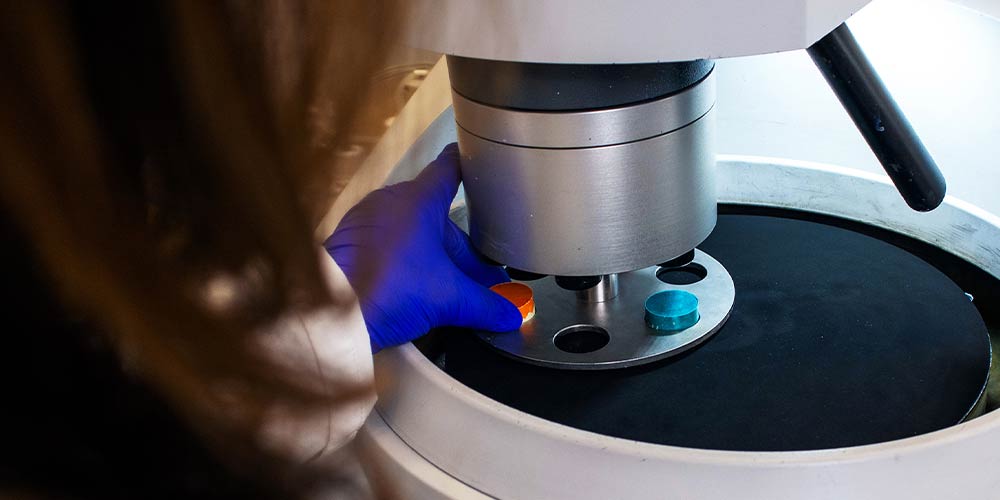
Metallography is the indispensable science of preparing and examining the internal structure of metals. With the broader term materialography, all solid materials are included and not only metals.
By meticulously preparing specimens and observing them under a microscope, it becomes possible to unveil features such as grains, phases, inclusions, and defects. These elements directly dictate a material’s properties and performance, including its strength, toughness, hardness, and resistance to wear or corrosion.

Consider materialography as the “forensic science for materials”, allowing engineers and researchers to uncover vital clues etched at the nanoscale. It is an unparalleled tool, providing a profound understanding of how material processing affects microstructure, and, consequently, how that microstructure influences real-world behaviour.
Historically, the discipline traces its roots to the pioneering work of British scientist Henry Clifton Sorby in the 19th century. Today, building upon Sorby’s foundational principles, modern metallography continues to evolve, integrating advanced preparation techniques with sophisticated microscopy to gain detailed insights and optimise materials for even the most demanding applications.
The Importance and Applications of Metallography
Across a diverse range of industries, metallography (and materialography) serves as an indispensable tool. Metallography is essential for:
- Quality Assurance: Verifying heat treatment results, confirming material specifications, and ensuring product consistency.
- Failure Analysis: Investigating the root causes of material failures by revealing microstructural evidence of damage or improper processing.
- Materials Research & Development: Enabling engineers to refine alloy compositions, optimise manufacturing processes, and predict material performance.
Achieving accurate and reliable materialographic results requires a systematic approach, where each step of the preparation process is executed with precision.
Key Steps in Materialographic Sample Preparation
The process to reveal a material’s true microstructure involves a series of steps, each designed to systematically remove damage from the previous stage.
1. Materialographic Cutting: Initial Sample Acquisition
The goal of sectioning is to obtain a representative sample from the area of interest while minimising the introduction of a new zone of thermal and mechanical deformation.
Abrasive cutting must be performed with ample cooling, not just to prevent thermal damage, but also to effectively flush away abrasive debris (swarf) that could otherwise be dragged through the cut.
2. Mounting: Specimen Protection and Support
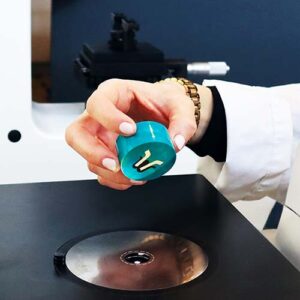
Mounting serves to simplify handling and provide excellent edge support when needed. This prevents the rounding of a specimen’s edges during subsequent grinding and polishing, which is essential for the accurate examination and measurement of surface layers, coatings, and heat-affected zones.
3. Grinding: Plane grinding
Plane grinding is a process of systematic material removal. Its purpose is to eliminate the deep, non-uniform damage layer from cutting by introducing a new, much shallower, and more controlled layer of deformation. This is achieved through a sequence of steps with progressively finer abrasives.
3.1 Fine Grinding
The grinding steps after plane grinding are called fine grinding, and they should prepare the surface for the polishing steps. Today it is very common to use rigid discs to keep the samples plane.
4. Polishing: Achieving a Mirror Finish
Polishing is typically a two-phase process. First, diamond polishing uses progressively finer diamond abrasives to efficiently remove the last grinding scratches.
This is followed by a final polishing stage, often using an oxide suspension, which employs a gentle chemical-mechanical action to remove the last, very thin layer of deformation, resulting in a pristine, artefact-free surface.
5. Etching: Revealing Microstructural Contrast
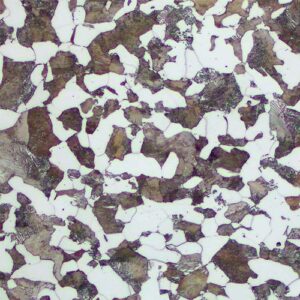
Etching is a process of creating contrast that can be performed by either modifying the surface of the sample or using the microscopic filters in an optical microscope.
When a chemical reagent is applied to the polished surface, one can either obtain a corroded layer or an interference layer (colour etching).
6. Microscopy: Examination and Analysis
The final step involves both qualitative and quantitative analysis. Microscopy is used to qualitatively identify features like phases and inclusions, and to perform quantitative measurements of features like grain size (e.g., per ASTM E112) or phase percentage, which are often critical for quality control.
Conclusion: Reading the Story of a Material
A prepared materialographic sample is more than just a polished surface; it is a story waiting to be told. It reveals the material’s history: how it was formed, if it was heat-treated correctly, how it has performed in service, and, in many cases, why it failed.
The primary goal of a good preparation is to make this story perfectly legible. Each step is designed to remove ‘noise’ and artefacts, ensuring that the final image you see in the microscope is the material’s true and unaltered story.
Once you have mastered the art of revealing this story with accuracy, the next step is to do so efficiently.